St Nicholas CEPrimary School
Curriculum
Our Curriculum at St Nicholas
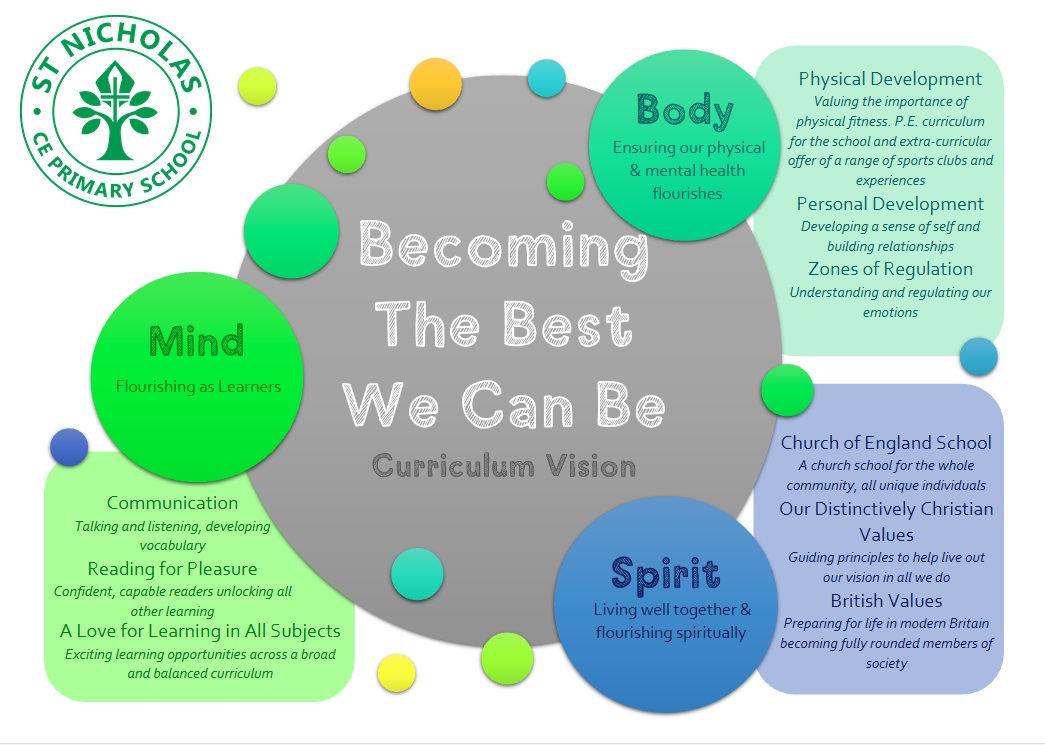
At St Nicholas, our curriculum is guided by our school vision: Becoming the Best We Can Be (Genesis 1:31). We believe every child deserves a learning journey that nurtures their mind, body and spirit, helping them grow into thoughtful learners, active participants and caring members of their community.
We create a structured, inclusive and nurturing environment where children flourish. Our curriculum is rooted in Christian values and a commitment to high standards, and it fosters:
- Flourishing Minds – through communication, creativity and a love of learning
- Flourishing Bodies – through physical activity, emotional awareness and personal growth
- Flourishing Spirits – by living well together and exploring the spiritual dimension of life
Our curriculum is shaped by Development Matters and the National Curriculum for England and Wales. We place high importance on strong foundations. From the earliest stages, children develop secure knowledge and skills that support future learning and help them understand what it means to be a learner. These foundations give every child the confidence to take on new challenges and grow as a successful learner.
To ensure purposeful progression and clarity across year groups, we use carefully selected schemes of work. These provide consistency while allowing teachers to focus on what matters most: creating meaningful and enriching experiences for every child.
Early Years Foundation Stage
In the Early Years, children follow the Early Years Foundation Stage curriculum guided by Development Matters, which builds firm foundations for future learning. While play, exploration and guided experiences remain central, there is also a clear focus on the critical building blocks such as communication, early reading and early mathematics. These foundations support our children to be ready for the next step in their learning journey.
Learning takes place indoors and outdoors, with purposeful activities that strengthen communication, problem-solving and relationships. Adults model language, introduce new ideas and guide children to practise key skills in meaningful contexts. This balanced approach ensures children grow in confidence, curiosity and independence while securing the strong start that underpins later success.
Key Stage 1
As children move into Key Stage 1, the curriculum becomes more structured while still allowing space for discovery and creativity. Children study:
- English and Maths through engaging, progressive schemes. (For more information about how we teach Phonics and Early Reading, please follow the link below.)
- Science, History, Geography, Art, DT, Computing, PSHE, Music and RE, taught through well-sequenced units that deepen knowledge and skills
- PE with specialist sports coaching and enrichment opportunities such as skateboarding workshops to build confidence and perseverance.
Key Stage 2
Children build on the strong foundations from EYFS and Key Stage 1 and begin to take more ownership of their learning. The curriculum remains ambitious, inclusive and rooted in our vision of Becoming the Best We Can Be.
Children study a broad range of subjects, including:
- English and Maths, taught through structured, progressive schemes that develop confidence and independence
- Science, History, Geography, Art, DT, Computing, PSHE, Music and RE, taught through well-sequenced units that deepen knowledge and skills
- PE, with specialist coaching, including work with Oxfordshire Cricket, to support teamwork, resilience and healthy habits
- Spanish (MFL), where pupils begin to explore language, culture and communication beyond their own experience
Learning is enriched through visits and workshops that bring topics to life and help children make meaningful connections with the world around them.
As children move into Key Stage 2, they are encouraged to think more deeply, ask thoughtful questions and make connections across subjects.
Learning is enhanced by access to our dedicated library, class iPads and Chromebooks, outdoor learning spaces, and resource areas for small group work.
Religious Education (RE)
We follow a bespoke curriculum that has been developed from the ODBE scheme of work. Our RE curriculum supports children to explore big questions, develop an understanding of a range of religious and non-religious world-views and reflect on their own beliefs and values. Through stories, discussion, enquiry and thoughtful classroom practice, children learn to appreciate diversity, show respect for others and think deeply about the world around them. You can read our RE policy here.
Parents have the right to withdraw their child from all or part of Religious Education. If you would like to discuss this or find out more about our RE curriculum, please just ask in the school office and we will be happy to help. Further information can can also be found in our RE policy, link below.
Relationships and Sex Education (RSE)
Schools are required to teach a new framework for Relationships, Sex and Health Education from September 2026.
Kapow’s new RSE & PSHE meets all the requirements of the statutory Relationships, Sex and Health Education (2025) set out by the DfE. It provides a clear, compliant curriculum that supports high-quality, progressive RSE & PSHE teaching and learning from EYFS to Year 6. Grounded in best practice and shaped by expert insight, Kapow RSE & PSHE builds understanding over time, ensuring learning is age-appropriate, inclusive and carefully sequenced.
Further information about RSE can be found in our policy, link below.
Frequently Asked Questions
When does Kapow Primary RSE & PSHE cover puberty and menstruation?
Children learn how bodies change as they grow in the Growing Up units in Years 2, 4 and 5. This understanding is revisited and built on through a spiral curriculum. In Year 4, teaching explicitly covers the changes during adolescence, including menstruation, and introduces the term ‘puberty’.
Which lessons can parents withdraw their child from?
Parents/carers may request to withdraw their child from the optional, non-statutory Year 6 Sex education unit How do people become parents and carers? Where a child is withdrawn from this unit, we will provide a Year 6 First Aid unit as an alternative.
Parents/carers do not have the right to withdraw their child from the following statutory components:
- Relationships education.
- Health education.
- Science lessons, including learning about puberty or human reproduction taught through Science.
- Any other PSHE content the school has chosen to include, such as citizenship or financial literacy.
We always welcome feedback on our curriculum and your comments are valued.
Links to Statutory Frameworks and Curriculum Documents
Our Curriculum Maps
Please see below to find out more information about the content of the curriculum in each academic year for every subject.